Calculating Net ProfitTax waits on the company type.
The software can finish its row tonight. The tax figure waits until we know how the company is taxed.
Name the company type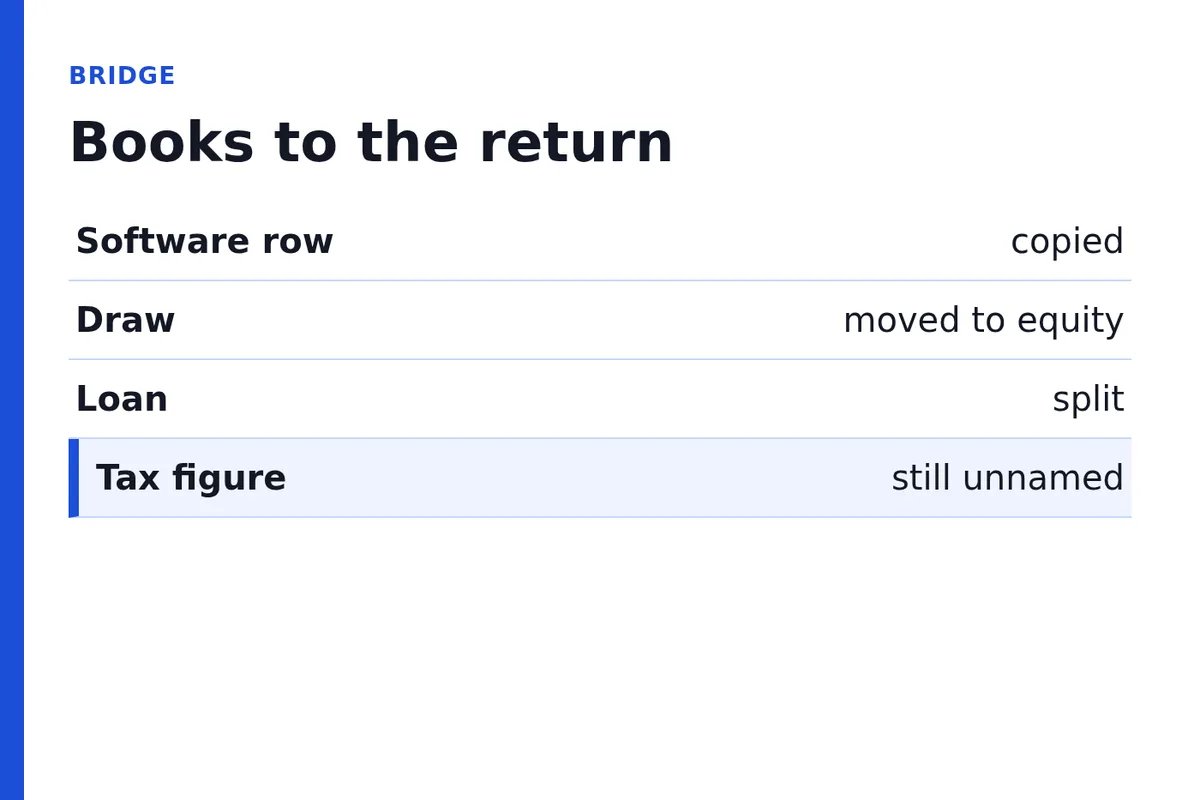
Four types, four tax figures.
Show the next lines
A sole owner, a partnership, an S corporation, and a C corporation do not share one tax figure. The software row can look identical in all four files. The return cannot. We ask the type before we let a tax sentence form.
If you are unsure of the type, that is a useful answer. We look at the election, the prior return, and the way the owner is paid. The brand name on the software screen does not tell us the type.
Changing the type is a formal step with a date. Making an S election puts the deadline on day fifteen of month three in that tax year. The date is said the way a person would say it. A late choice does not get a made-up outcome on these pages.
Until the type is settled, conversation stays on the software row and the cash change. A closed month can name both. The tax figure stays unnamed.
If you do not yet know how the company is taxed, write that down in those words. Unknown is a useful answer. A guessed type is not.
The return reads closed months.
Show the next lines
A tax figure is not a fresh invention in March. It is the closed months, adjusted for items the return treats differently from the books. If the months never closed, the adjustments have nothing solid under them.
Common differences are the ones a close already flagged. A draw that was sitting in expenses. A loan draft that was never split. A deposit that was the owner, coded as sales. Equipment that was expensed when it should have been a longer-lived asset. Each of those changes the software row and the tax figure in ways a stranger cannot see from the last line alone.
We prepare a short bridge from the books to the return in words an owner can read. The bridge names each difference. It does not hide them inside a single subtracted total.
We schedule around the federal calendar without treating it as a reason to skip the close. Partnership and S corporation filings cluster near the middle of March. Individual filings cluster near the middle of April. Estimated payments are spaced across four points in the year.
Owner pay depends on the type.
Show the next lines
How you pay yourself is part of the type. A sole owner takes a draw. A partner takes a distribution, and sometimes a guaranteed payment. An S corporation owner who works in the company is on payroll for the work, and distributions are a separate idea. A C corporation owner may be on payroll and may also take a dividend.
On payroll, our piece is the setup. Registrations, pay items, and a login that opens are the work product. After that, payday keeps going out from the provider already on the account. That recurring run is not a job we keep.
If the books have been calling wages a draw, or a draw wages, the software row and the tax figure are both bent. We fix the coding in a closed month before either figure is discussed outside the practice.
Forms for contractors from the prior year leave near the end of January. If you paid people outside payroll, bring that list while the month is still open. Waiting until the form is overdue makes the close harder, not clearer.
What we will not pretend.
Show the next lines
We will not relabel the software row as taxable income just to finish an email. The person who asked might accept the shortcut. The return will reject it later, when there is less time to explain the coding.
A lender who wants assurance on the statements has to hire a firm that signs that kind of work. We can pass along the closed months as the record those people read. Our name does not go on that signature line.
We will not quote a rate, a penalty, or a savings number on these pages. Your facts decide those. The pages only insist that the tax figure keep its own name.
Bring the company type if you know it, and the sentence the other person used if you have it. Unknown is allowed in the first note. That note is enough to start.
Name the company type.
The tax figure waits on this answer.

You will be talking to the Steven Palmieri practice.