Calculating Net ProfitOne month with three labels.
A made-up month, with no amounts, is enough to show where the three labels part ways.
Describe your month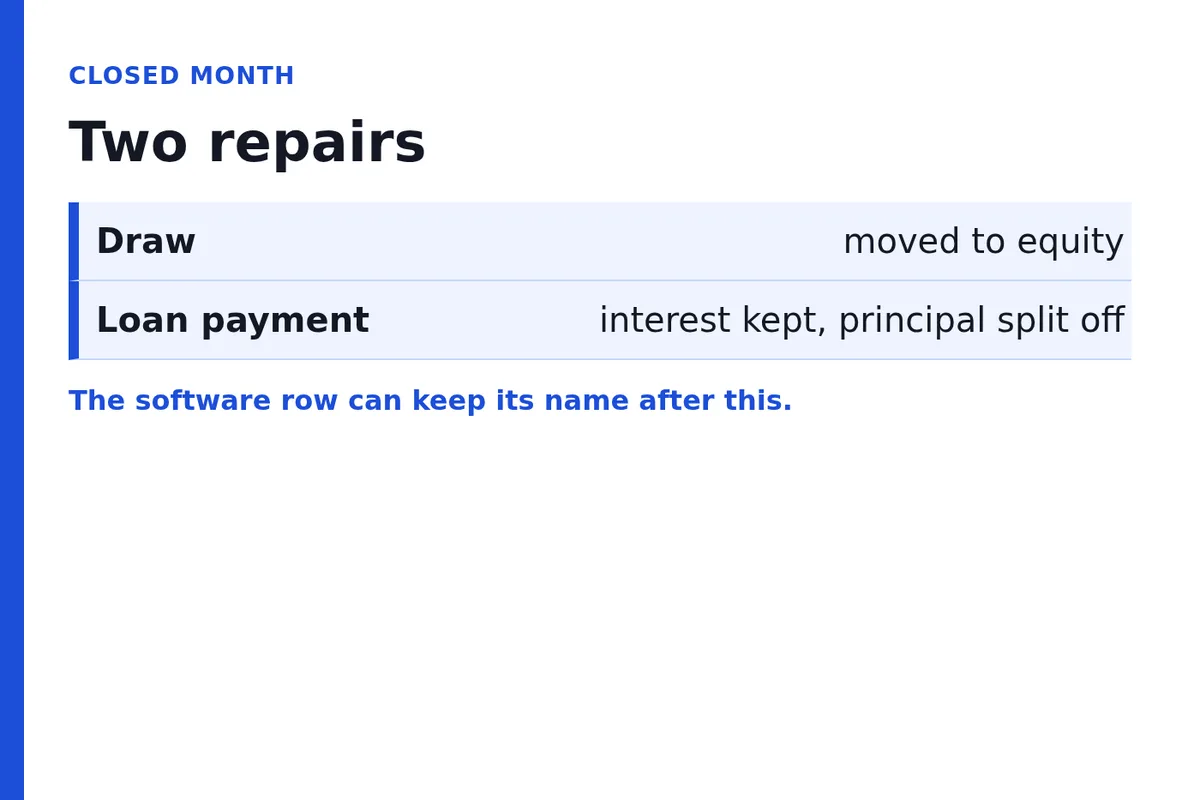
How the month opens.
Show the next lines
Picture a shop that already sells, already pays a lender, and already pays its owner. The software has a report. The bank has a balance. Nobody has asked whether those two pages are talking about the same thing.
We open the month by tying the bank, the cards, and the loan balances to the books. Until that tie exists, every label is a rumor. The tie is not glamorous. It is the floor under the sentences we are willing to say.
This example uses no amounts on purpose. Amounts tempt people to do arithmetic and skip the labels. The labels are the lesson.
Where the software row bends.
Show the next lines
The owner took money and the software filed it with expenses. The row at the bottom looks worse than the work. We move the draw to equity. The row changes. Nothing about the week of jobs changed. The coding did.
The lender was paid in one draft. Part of it was interest, which can stay with the costs. The rest was principal, which reduces the loan. Leaving the whole draft in expenses bends the row a second time.
A deposit arrived that was the owner putting money in, and the software called it sales. Sales rise. The row rises. The work did not. We relabel the deposit. The row comes back to the work.
After those three repairs, the software row is allowed to keep its name. Before them, it is only a printout.
Where cash tells a different story.
Show the next lines
In the same month the bank can drop. The drop might be the draw, the principal, a tax estimate, or a machine the shop bought. None of those should be smuggled back into the software row to make the bank feel consistent.
We list them under the cash change. The owner can see why the account moved. The stranger who asked for profit does not get to treat the account as the answer.
If a card was paid off in the same month, that payment is cash too. The costs were already, or will be, the charges themselves, in the months they belong to.
Where tax still waits.
Show the next lines
Even a clean software row is not the tax figure. The company type is still the gate. A sole owner and an S corporation can show the same repaired row and owe a different conversation.
The bridge from the books to the return is a later page, built only when the months exist. One clean month is a start. A year is a longer stretch of closed months, and we do not pretend otherwise.
If your real month has one of these bends, describe it in the form without amounts. Expect the reply to name the label that shifted, and to say whether that month can carry a sentence out of the practice.
Send one month.
Skip the amounts. Name the kind of row that looks wrong.

You will be talking to the Steven Palmieri practice.